Whites
Hairstreaks
Blues and Coppers
Admirals
Vannesids
Fritillaries
Browns
_ copy.jpg)
Orange tip female easily mistaken for a range of white butterflies, but notable for distictly rounded top wings - see below mating small white

| Year | First | |
| 1976 | May 9 EY | |
| 1977 | April 23 EY | |
| 1978 | May 20 EY | |
| 1979 | May 12 WH | |
| 1980 | May 1 RUX | |
| 1981 | May 4 ORP | |
| 1982 | April 21 RUX | |
| 1983 | May 14 WH | |
| 1984 | April 20 SH | |
| 1985 | May 6 WH | |
| 1986 | May 19 WH | |
| 1987 | April 27 WH | |
| 1988 | May 5 WH | May 2 BR |
| 1989 | April 14 EY | |
| 1990 | March 18 EY | March 31 BR |
| 1991 | April 11 EY | May 6 BR |
| 1992 | April 27 EY | Apl 21 BR |
| 1993 | Apl 20 BR | |
| 1994 | May 1 EY | Apl 30 BR |
| 1995 | May 7 BR | |
| 1996 | April 28 BR | |
| 1997 | April 12 BR | |
| 1998 | April 22 BR | |
| 1999 | April 17 BR | |
| 2000 | April 8 BR | |
| 2001 | April 28 BR | |
| 2002 | April 3 EY | April 3 BR |
| 2003 | April 18 BR | |
| 2004 | April 24 BR | |
| 2005 | April 10 BR | |
| 2006 | May 3 BR | |
| 2007 | April 7 BR | |
| 2008 | April 20 BR | |
| 2009 | April 2 BN | April 13 BR |
| 2010 | April 17 BR | |
| 2011 | Mar 14 EY | April 6 BR |
| 2012 | Apl 2 BC | April 2 BR |
| 2013 | Apl 30 BC | May 2 BR |
| 2014 | Apl 9 Kn Pk | Apl 10 BC |
| 2015 | Apl 15 HE | |
| 2016 | BC | |
| 2017 | BC | |
| 2018 | BC | |
| 2019 | BC | |
| 2020 | 1st wk April |
3rdwk june |
| 2021 | BC | |
| 2022 | BC | |
| 2024 | 2 wk May | 24º |
| 2025 | 3rd wk april | 25º |
Submit Your Records & Comments Here
Orange Tip Male (anthocharis cardamines)
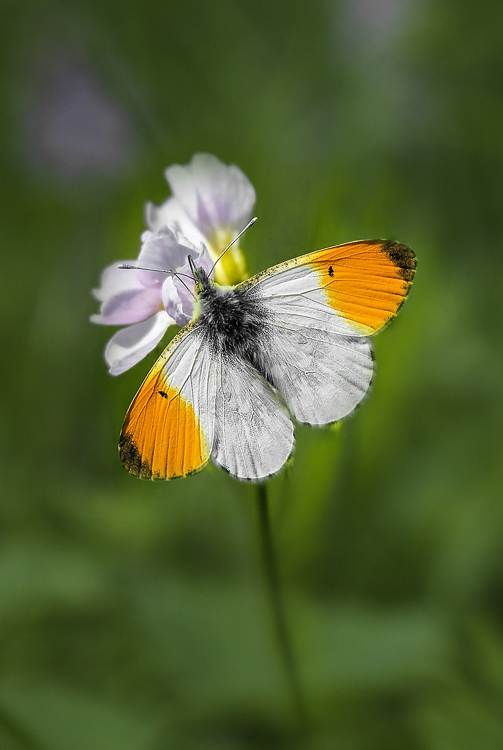
Wingspan - 40 mm
The Orange Tip is the signature butterfly for the arrival of Spring for anyone who has walked or cycled the lanes and footpaths of this small corner of Nort East Kent. As one of the first Spring emergents, i.e., non hibernating in butterfly form, the orange tip is a good indicator of climate change. In the study I have conducted, the butterfly demonstrates a full months difference in its pattern of emergence between the 1970's and 2025 - even when taking our naturally variable weather patterns into account. 1976 and 2025 being almost identical 'drought' summers.
Habit: Semi territorial, The unmistakable orange winged males emerge first and will often be found patrolling close to its foodplant along a particular stretch of lane, hedgerow or woodland margin. This patrolling behaviour is almost certainly a search mechanism the male to locate and mate with the more reticent and later emerging females. The season for the butterfly is extensive, stretching from April well into May and occasionally June, when the Spring weather is changeable and uncertain.
Single brooded: over winters as a pupae hooked up on a thread in a vee from a twig. The larvae is unexceptional, thin and greenish and mimics the pods of the hedge garlic on which it feeds*.
Larval Foodplant: garlic mustard (and relations), cuckoo flower* The biennial nature of the orange tip's main foodplant locally, creates a conundrum and where at the beginning of this study it was abundant in the Eynsford lanes, an increase in traffic and savage laneside management has left the foodplant small margin and with that the loss of orange tip butterflies.
Status: Under some threat from climate change and the mismatch of butterfly and foodplant availability. Numbers fluctuate, but diminished from former times. interference of habitat through modern hedge management, increased road traffic on the lanes, and pesticide use, have accounted for much of this. Locally, in Bromley Common, encroachment from scrub and tree growth on the margins where it breeds is a factor as perhaps the less wet conditions that encourage its foodplant in Climate Change.
WH - White Hill, SH-Shoreham, BC-Bromley Common, Ha-Hayes BN-Bromley North, BR-Bromley All, Ey-Eynsford, Orp-Orpington, Rux -Ruxley Res Kn Pk - Knoll Pk
© Rodney Compton - special thanks to Howard Walmsley and the late David Davis for inspiring this study