Emergence
| Year | First | Second |
| 1976 | 3wk June | 2wk Nov |
| 1977 | 2wk July | |
| 1978 | 2 wk Aug | |
| 1979 | Aug 15 | |
| 1980 | May 19 | Oct 15 |
| 1981 | ||
| 1982 | May 14 | Oct 25 |
| 1983 | ||
| 1984 | June 27 | |
| 1985 | ||
| 1986 | June 25 | Dec 26 |
| 1987 | May 30 BIC | |
| 1988 | June 12 | |
| 1989 | May 29 EY | Oct 20 |
| 1990 | Jun 7 BIC | |
| 1991 | July 18 BIC | |
| 1992 | May 17 BIC | |
| 1993 | May 23 BIC | |
| 1994 | July 3 BIC | |
| 1995 | July 9 BIC | |
| 1996 | May 19 BIC | |
| 1997 | June 7 BIC | |
| 1998 | May 3 BN | |
| 1999 | May 22 BIC | |
| 2000 | March 7 BIC | |
| 2001 | April 7 BN | |
| 2002 | Jan 9 BN | |
| 2003 | May 5 BIC | |
| 2004 | May 31 BIC | |
| 2005 | Jun 4 BIC | |
| 2006 | Jan 20 BC | |
| 2007 | Mar 8 BIC | |
| 2008 | Feb 13 BIC | |
| 2009 | Jun 28 BIC | |
| 2010 | May 17 BIC | |
| 2011 | Apl 23 BC |
|
| 2012 | Jan 6 HA | Nov 14 BC |
| 2013 | May 22 BIC | |
| 2014 | May 7 | |
| 2015 | May 27 BC | Dec 13 |
| 2016 | May 7 BR | |
| 2017 | May 2 BR | |
| 2018 | Apl 4 BR | |
| 2019 | Apl 26 | |
| 2020 | Mar 20 | |
| 2021 | may 5 | |
| 2022 | Jan 1* BR | |
| 2023 | May 7 BR | |
| 2024 | Feb 12 | |
| 2025 | Apl 5th WH | Oct 22 BC |
all areas covered by this survey
Whites
Hairstreaks
Blues and Coppers
Admirals
Vannesids
Fritillaries
Browns
1976-2025
Red Admiral
Red Admiral (vanessa atlanta)
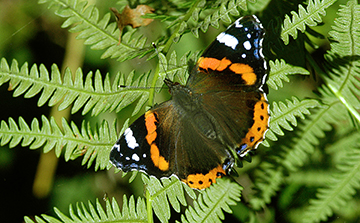
Red admiral - topwing
Wingspan - 65 -75 mm - female larger
Contrary to earlier popular understanding and even misidentification (small tortoiseshell) of the Red Admiral as a resident butterfly, most Red Admiral butterflies were in fact migrant butterflies, originating in the near continent. Over the period of this study this has changed and the new climate gradients have altered the red admiral's status to the extent it can now be regarded as semi resident. However, the butterfly is undoubtedly subject to reinforcement from overseas as the summer progresses so the butterfly can be seen well into autumn and beyond. The adaptation to its residency as a UK butterfly shows up in how the butterfly is apt to come out, or not quite manage hibernation, hence it can be seen on New Year's eve in one year and New Year's day, the day after.
The name Red Admiral almost became generic for any of the UK's nymphalidae or bright winged butterflies (especially in confusion with the small tortoiseshell), but as can be seen, the flashes of scarlet are all that it has in reference to the redness of its name. The term admiral comes from the Victorian epithet admirable and has no reference to seafaring.
Habit: fly's far and wide in our area and at any time - often seen in rough uncultivated parks and gardens and along woodland margins where nettles grow. In former times, the butterfly was often seen semi comatose on the rotting fruit from the many plum trees cultivated in larger gardens and orchards. This large hardy butterfly is a powerful flyer and in the warmest winters comes out of hibernation and flutters in the weak January/February sun.
Single brooded: migrates to the UK as a butterfly and some now over winter - the larvae are typically spiny turning darker and dispersing to pupate. The larvae from some summer brood butterflies are known to overwinter, so unlike other resident related species that hibernate, the red admiral is also a spring emergent.
Larval Foodplant: stinging nettle and others, eggs laid in a group hibernaculum.
Status: not under threat
WH - White Hill Shoreham, BC - Bromley Common, Ha Hayes --BN Bromley North - Ey Eynsford - Orp Orpington BIC- Bickley etc
Thanks to Howard and David for their valued participation