Whites
Hairstreaks
Blues and Coppers
Admirals
Vannesids
Fritillaries
Browns
Butterflies that are similar superficially the Comma seen with wings open is unlike the specled wood, but in flight it is also found on woodland margins and sunlit glades, flight more abrupt
First Emergence
| Year | First | Second |
| 1976 | *nr | |
| 1977 | *nr | |
| 1978 | *nr | |
| 1979 | *nr | |
| 1980 | 30 Apl Orp | |
| 1981 | 20 Apl Orp | |
| 1982 | 19 Apl Orp | |
| 1983 | 26 Apl Orp | |
| 1984 | 24 Apl Orp | |
| 1985 | 26 Apl Orp | |
| 1986 | nr | |
| 1987 | 26 Apl Ey | |
| 1988 | 14 May BR | |
| 1989 | 8 Apl Ey | |
| 1990 | 20 Mar Ey | |
| 1991 | 8 Apl BR | |
| 1992 | 3 May BR | |
| 1993 | 2 May BR | |
| 1994 | 30 April BR | |
| 1995 | 4 May BR | |
| 1996 | 26 Apl | |
| 1997 | 14 Jun BR | |
| 1998 | 16 May BR | |
| 1999 | 18 April | |
| 2000 | 22 Mar BN | |
| 2001 | 12 May BR | |
| 2002 | 21 Mar BN | |
| 2003 | 22 April BR | |
| 2004 | 24 April BR | |
| 2005 | 16 April BR | |
| 2006 | 27 April BR | |
| 2007 | 7 April BR | |
| 2008 | 23 April BR | |
| 2009 | 18 April BR | |
| 2010 | 22 April BR | |
| 2011 | 17 April BR | |
| 2012 | 30 Mar BN | |
| 2013 | 3 May BC | |
| 2014 | 7 April BR | |
| 2015 | 12 April BR | |
| 2016 | 20 April BR | |
| 2017 | Mar 30 BR | |
| 2018 | April 19 Br | |
| 2019 | 17 April BC | |
| 2020 | April 10 BR | 2021 | April 16 BC | 2022 | April 16 BR | 2023 | Aprl 29 BR | 2024 | April 23 BC | 2025 | 2 April BR | AUG 30 BR |
Map of area covered for records
Butterfly Survey 1976-2025


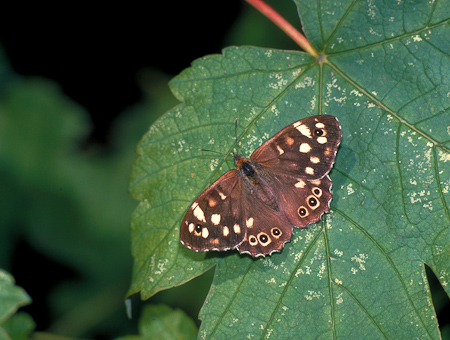
wingspan: 42mm
Habit: Inhabits woody glades and clearings in almost all of the neglected formerly coppiced woodland in our area, also seen in wooded parks and large gardens and nearby areas. Flys up at disturbance, only occasionally to a high point, mostly it will be seen at low to waist level on bushes and lower branches.
Double brooded - can be seen on the wing from early Spring until late September, though recent observations in Eastern areas of Kent, note that the butterlies seen approaching autumn are likely a third brood or a part of a continuous second brood.
Larval Foodplant: several grasses, cocks foot, false brome etc., Caterpillar, bright green with fine white bristles and lines
Status: The Speckled Wood butterfly became very common as the Wall Brown declined. In the areas under study this coincides with general woodland progression, but it's almost certain other factors come into play. Like many butterflies, it has receded from a peak in the 1980's and though it would be entirely speculative, the change in climate gradient is almost certainly a factor in its current status as a very common woodland edge butterfly.
History: The range of the speckled wood butterfly was a matter of interest to © Chalmers Hunt in his seminal work Butterflies and Moths of Kent. It coincides perfectly with what we now understand of the butterfly in 2025*. He writes that the butterfly became virtually extinct in Kent between 1915 and 1940, its fate during this period, as suspected by me, being linked to the Wall Brown. This phenomenon and the recession of the wall brown to coastal regions, coincides with the phenomenon of Acid Rain caused by the industrial energy producers burning fossil fuels, especially during the affluent 1960's, however, being a woodland butterly, the Speckled Wood was able to escape the worst implications of acid rain poisoning 'its' grassy foodplant. Earliest recordings go back to the 1800's - late brood seen in the Dover area of Kent. What we now know of this butterfly and our local countryside suggests that the rise and recession of the two butterflies is also linked to dramatic changes in habitat, where grazing interchanged with scrub and woodland progression, due to the UK joining the CAP with emphasis on rape seed planting, and the abandonment of hillside grazing. This is an assumption, but it paints a picture we can explore by looking at some more recent maps of the survey area and note its implications for Kent as a whole.
© Rodney Compton - Thanks to the invaluable recording by Howard Walmsley